EB-5 Immigrant Investor Program
USCIS administers the EB-5 Program. Under this program, entrepreneurs (and their spouses and unmarried children under 21) are eligible to apply for a green card (permanent residence) if they:
- Make the necessary investment in a commercial enterprise in the United States; and
- Plan to create or preserve 10 permanent full-time jobs for qualified U.S. workers.
This program is known as EB-5 for the name of the employment-based fifth preference visa that participants receive.
Congress created the EB-5 Program in 1990 to stimulate the U.S. economy through job creation and capital investment by foreign investors. In 1992, Congress created the Immigrant Investor Program, also known as the Regional Center Program. This sets aside EB-5 visas for participants who invest in commercial enterprises associated with regional centers approved by USCIS based on proposals for promoting economic growth.
About the EB-5 Visa Classification
Visa Classification Description
USCIS administers the EB-5 program, created by Congress in 1990 to stimulate the U.S. economy through job creation and capital investment by foreign investors. Under a program initially enacted as a pilot in 1992, and regularly reauthorized since then, investors may also qualify for EB-5 classification by investing through regional centers designated by USCIS based on proposals for promoting economic growth. On March 23, 2018, the President signed Public Law 115-141 extending the Regional Center Program through Sep. 30, 2018.
USCIS policy on EB-5 adjudications is contained in Volume 6, Part G of the USCIS Policy Manual.
All EB-5 investors must invest in a new commercial enterprise, which is a commercial enterprise:
- Established after Nov. 29, 1990, or
- Established on or before Nov. 29, 1990, that is:
- Purchased and the existing business is restructured or reorganized in such a way that a new commercial enterprise results, or
- Expanded through the investment so that at least a 40-percent increase in the net worth or number of employees occurs
Commercial enterprise means any for-profit activity formed for the ongoing conduct of lawful business including, but not limited to:
- A sole proprietorship
- Partnership (whether limited or general)
- Holding company
- Joint venture
- Corporation
- Business trust, or
- Other entity, which may be publicly or privately owned.
This definition includes a commercial enterprise consisting of a holding company and its wholly owned subsidiaries, provided that each such subsidiary is engaged in a for-profit activity formed for the ongoing conduct of a lawful business.
Note: This definition does not include noncommercial activity such as owning and operating a personal residence.
Job Creation Requirements
An EB-5 investor must invest the required amount of capital in a new commercial enterprise that will create full-time positions for at least 10 qualifying employees.
- For a new commercial enterprise not located within a regional center, the full-time positions must be created directly by the new commercial enterprise to be counted. This means that the new commercial enterprise (or its wholly owned subsidiaries) must itself be the employer of the qualifying employees.
- For a new commercial enterprise located within a regional center, the full-time positions can be created either directly or indirectly by the new commercial enterprise.
- Direct jobs are those jobs that establish an employer-employee relationship between the new commercial enterprise and the persons it employs.
- Indirect jobs are those jobs held outside of the new commercial enterprise but that are created as a result of the new commercial enterprise.
- In the case of a troubled business, the EB-5 investor may rely on job maintenance.
- The investor must show that the number of existing employees is being, or will be, maintained at no less than the pre-investment level for a period of at least 2 years.
A troubled business is a business that has been in existence for at least two years and has incurred a net loss during the 12- or 24-month period prior to the priority date on the immigrant investor's Form I-526. The loss for this period must be at least 20 percent of the troubled business' net worth prior to the loss. For purposes of determining whether the troubled business has been in existence for two years, successors in interest to the troubled business will be deemed to have been in existence for the same period of time as the business they succeeded.
A qualifying employee is a U.S. citizen, lawful permanent resident or other immigrant authorized to work in the United States including, but not limited to, a conditional resident, a temporary resident, an asylee, a refugee, or a person residing in the United States under suspension of deportation. This definition does not include the immigrant investor; his or her spouse, sons, or daughters; or any foreign national in any nonimmigrant status (such as an H-1B nonimmigrant) or who is not authorized to work in the United States.
Full-time employment means employment of a qualifying employee by the new commercial enterprise in a position that requires a minimum of 35 working hours per week. In the case of the regional center program, "full-time employment" also means employment of a qualifying employee in a position that has been created indirectly that requires a minimum of 35 working hours per week.
A job-sharing arrangement whereby two or more qualifying employees share a full-time position will count as full-time employment provided the hourly requirement per week is met. This definition does not include combinations of part-time positions even if, when combined, the positions meet the hourly requirement per week.
Jobs that are intermittent, temporary, seasonal, or transient in nature do not qualify as permanent full-time jobs. However, jobs that are expected to last at least 2 years are generally not considered intermittent, temporary, seasonal, or transient in nature.
Capital Investment Requirements
Capital means cash, equipment, inventory, other tangible property, cash equivalents and indebtedness secured by assets owned by the alien entrepreneur, provided that the alien entrepreneur is personally and primarily liable and that the assets of the new commercial enterprise upon which the petition is based are not used to secure any of the indebtedness. All capital shall be valued at fair-market value in United States dollars. Assets acquired, directly or indirectly, by unlawful means (such as criminal activities) shall not be considered capital for the purposes of section 203(b)(5) of the Act.
Note: The immigrant investor must establish that he or she is the legal owner of the capital invested. Capital can include the immigrant investor's promise to pay (a promissory note) under certain circumstances.
Required minimum investments are:
- General. The minimum qualifying investment in the United States is $1 million.
- Targeted Employment Area (High Unemployment or Rural Area). The minimum qualifying investment either within a high-unemployment area or rural area in the United States is $500,000.
A targeted employment area is an area that, at the time of investment, is a rural area or an area which has experienced unemployment of at least 150 percent of the national average rate.
A rural area is any area not within either a metropolitan statistical area (as designated by the Office of Management and Budget) or the outer boundary of any city or town having a population of 20,000 or more according to the most recent decennial census of the United States.
Capital Investment Requirements
Capital means cash, equipment, inventory, other tangible property, cash equivalents and indebtedness secured by assets owned by the alien entrepreneur, provided that the alien entrepreneur is personally and primarily liable and that the assets of the new commercial enterprise upon which the petition is based are not used to secure any of the indebtedness. All capital shall be valued at fair-market value in United States dollars. Assets acquired, directly or indirectly, by unlawful means (such as criminal activities) shall not be considered capital for the purposes of section 203(b)(5) of the Act.
Note: The immigrant investor must establish that he or she is the legal owner of the capital invested. Capital can include the immigrant investor's promise to pay (a promissory note) under certain circumstances.
Required minimum investments are:
- General. The minimum qualifying investment in the United States is $1 million.
- Targeted Employment Area (High Unemployment or Rural Area). The minimum qualifying investment either within a high-unemployment area or rural area in the United States is $500,000.
A targeted employment area is an area that, at the time of investment, is a rural area or an area which has experienced unemployment of at least 150 percent of the national average rate.
A rural area is any area not within either a metropolitan statistical area (as designated by the Office of Management and Budget) or the outer boundary of any city or town having a population of 20,000 or more according to the most recent decennial census of the United States.
EB-5 Investors
Petition/Application Process
- File Form I-526, Immigrant Petition by Alien Entrepreneur
- Following approval of the Form I-526 petition, either:
- File Form I-485, Application to Register Permanent Residence or Adjust Status, with USCIS to adjust status to a conditional permanent resident within the United States, or
- File DS-260, Application for Immigrant Visa and Alien Registration, with the U.S. Department of State to obtain an EB-5 visa abroad to seek admission to the United States.
Upon the approval of a Form I-485 application or upon admission into the United States with an EB-5 immigrant visa, the EB-5 investor and derivative family members will be granted conditional permanent residence for a 2-year period.
EB-5 Application Process
Wire transfer to escrow account
- Fill out Investor Questionnaire.
- Regional Center provides PPM to investors.
- Investor signs subscription documents.
- Investor wires $550,000 to escrow account.
USCIS I-526 Petition
- Immigration lawyer submits I-526 petition to USCIS.
DS 260/ I-485
- Immigration lawyer schedules immigration visa interview with US Embassy (overseas).
- Immigration lawyer files Adjustment of Status Petition (US).
Conditional Green Card
- Investor receives conditional Green Card.
Permanent Green Card
- Immigration lawyer files I-829 petition to remove conditions.
- Investor receives permanent Green Card.
EB-5 Immigrant Investor Regional Centers
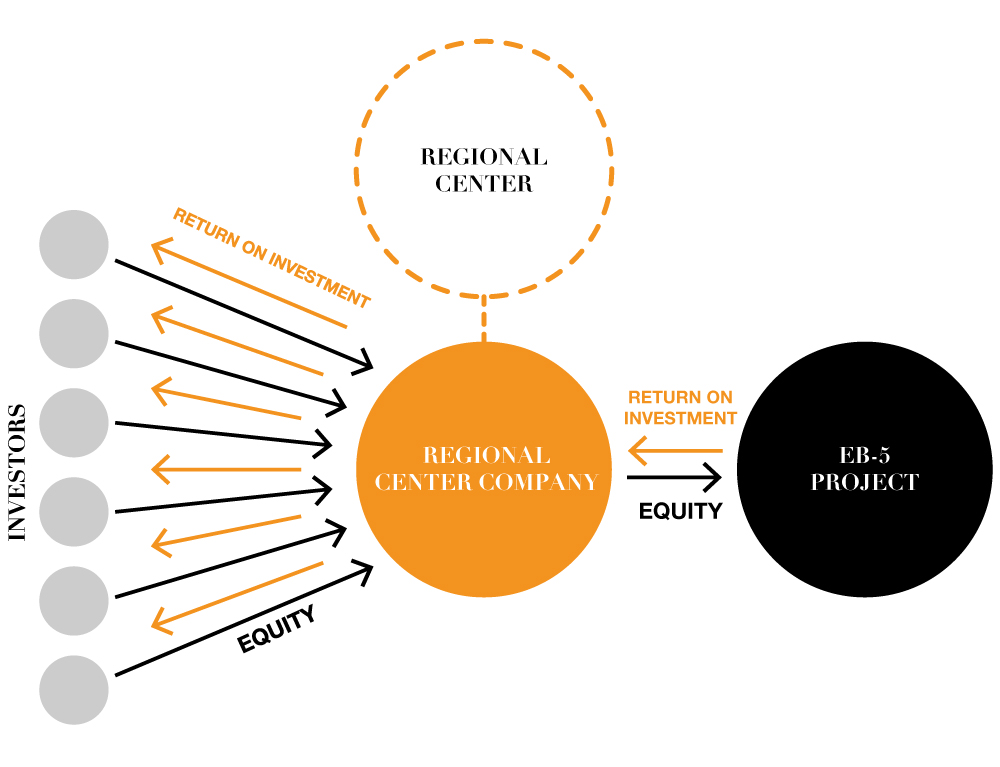
An EB-5 regional center is an economic unit, public or private, in the United States that is involved with promoting economic growth. Regional centers are designated by USCIS for participation in the Immigrant Investor Program.
Regional Center Structure Diagram